Your Cousin's Shaadi Has a Landing Page Now
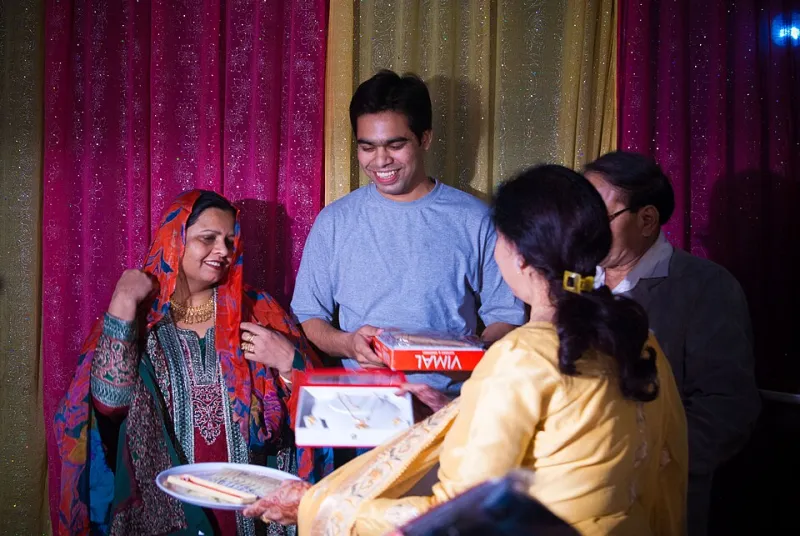
Photo: wedstories.studio, CC BY-SA 2.0, via Wikimedia Commons
The first thing Priya Raghunathan's cousins did when the wedding site went live was not RSVP. It was scroll. Then screenshot. Then forward to a group chat called, and I am quoting directly, "Raghunathan Shaadi Logistics (DO NOT MUTE)."
Within twenty minutes, someone had noticed that the site's timeline listed the mehndi as starting at 4 p.m. and the family WhatsApp had said 3:30. Within forty, an aunt had emailed a formal objection. By dinner, Priya's mother was on the phone asking why the FAQ page said "no plus-ones" when cousin Dev's girlfriend had, quote, "been around for a while now."
"I built the site to stop getting forty text messages a day," Priya said. "It became a second job. A beloved second job. But a second job."
The shaadi website is not a new invention — couples have been slapping a Zola page together since roughly the era of the iPhone 4. What's changed is the ambition. The 2026 version of the desi wedding site is a full editorial product: a multi-page build with a hero shot from the engagement shoot, a downloadable itinerary, a dress code color story, a Spotify playlist that gets updated weekly, a "Meet the Wedding Party" section with photos that took three rounds of approval, and a travel page with hotel blocks, airport tips, and — critically — a map to the nearest Patel Brothers.
From invitation to internet property
"The paper invite is a keepsake. The site is the operating system," said Ayesha Merchant, a Bay Area graphic designer who has built nineteen wedding sites in the last two years, mostly for friends of friends who found her through Instagram. Her packages start around $600 and go up from there, and she now has a two-month waitlist during wedding season.
What her clients want, she said, is cohesion. The same marigold-and-pink palette on the save-the-date, the site, the mehndi signage, and the cocktail napkins. They want the site to feel like the wedding looks before anyone gets there.
"Couples are treating it like a brand launch," Merchant said. "They've been to eleven weddings in three years. They know exactly what annoyed them at the other ten, and they're building fixes into the site. Where do I park. What do I wear. Why is the baraat at 9 a.m. when it's ninety degrees. The site is them answering those questions in advance."
Andrey and Simran, a Dallas couple who married in October, went further: a password-protected "Family Only" page with the ceremony logistics and the more granular religious details for out-of-town relatives who had never attended a Sikh wedding. They recorded a two-minute video explaining what happens at Anand Karaj — when to sit, when to stand, what the four laavan actually mean.
"My college friends were texting me asking what to wear and whether they could take photos in the gurdwara," Simran said. "I was like, I love you, but I cannot answer this for the fortieth time while I'm also picking a caterer. So I made a page."
The FAQ is where the aunties get heard
Here is the thing nobody says out loud: the FAQ page is a family constitution disguised as a webpage.
Do you have a dress code? Yes — and listing "cocktail Indian" or "garden party pastels" is the polite way of preventing four separate relatives from wearing the same red lehenga. Are kids invited? That question, on a public web page, is the diasporic equivalent of a diplomatic cable.
"I've written the phrase 'we love your children, but this is an adults-only celebration' more times than I've written my own name," Merchant said. "And every single time, the couple comes back and asks me to soften it. Then the mom comes back and asks me to soften it more. Then the uncle calls."
Priya's site has a question in her own words: "Can I bring my mom's sister's family? They're basically immediate family." Her answer, bolded and double-checked by her fiancé: "Unfortunately, we're at capacity. Please know it was genuinely painful to say that." She says it's the single most-visited page on the site.
RSVP: the plot twist nobody built for
The RSVP form is the only part of the site that talks back. And it has no chill.
Couples reported the same cluster of horrors: people entering "3" in a party-size field after being told the headcount is fixed. People leaving the dietary restriction box blank and then emailing in week three to say they've gone vegan. People RSVP'ing "maybe." People RSVP'ing yes on the website and no on the phone, to a different relative, on the same day. One couple I spoke to had a relative submit the form six times, each with a different spelling of her own name.
"We had a cousin RSVP for five," said Karan Mehta, whose wedding site he and his wife built together in a shared Google Doc that still gives him hives. "We invited two. His justification was that his parents were 'technically local.' They live in Ohio."
Merchant's workaround is design-based: a form with hard limits, a required meal selection, and a confirmation email that restates the party size in bold. "You can't make people behave," she said. "You can make the form say 'Your party is confirmed for two guests' in 40-point font. That helps."
The deeper value, though, isn't crowd control. It's research. Couples are now using the site to track who's actually flying in, who needs a ride from the airport, and which relatives need a vegetarian, Jain, or no-onion-no-garlic option. It's a wedding-planning CRM with a nice font.
Then the wedding ends and it becomes an archive
Most wedding sites are dead within a month of the last sangeet. Not these. Merchant's clients now pay a small annual fee to keep theirs live, and a few have quietly repurposed the URL into something else entirely: a repository for the ceremony video, the speeches, the photos from every cousin who promised to send theirs and didn't.
Simran's site now has a page called "The Photos We Actually Got," updated every few months as relatives dig things out of their camera rolls. Andrey uploaded the kirtan recording from the morning program. Their site gets traffic on wedding anniversaries from people who went once and liked it.
"My grandmother isn't on Instagram," Simran said. "But she can open a link. She's opened that link maybe two hundred times."
Which might be the real plot twist. The site was never about the logistics. It was about making a permanent, tidy place for a family that is usually spread across four time zones and one very chaotic group chat — a place where the answers are written down, the marigolds load properly on mobile, and the RSVP, bless it, is finally closed.